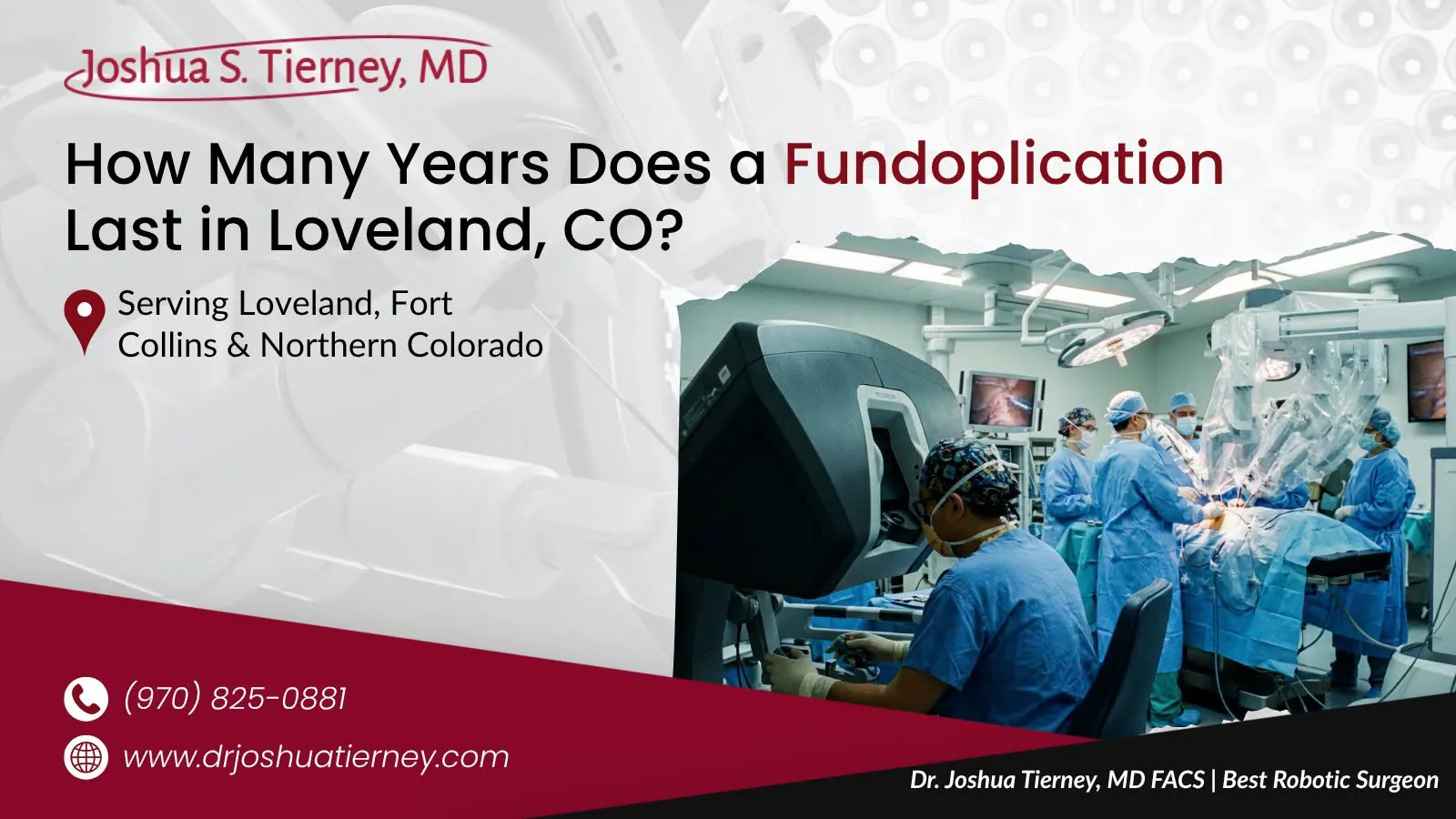

A fundoplication has no fixed expiry date, and most patients stay off acid-reducing medication long term, though the wrap can loosen over time and published robotic series report recurrence requiring further surgery in roughly four to nine percent of patients.
The question usually arrives with a number attached. Someone has heard that a wrap lasts ten years, or seven, or that it fails eventually and you may as well stay on medication. That framing is understandable, because most surgical repairs do get discussed in terms of lifespan, and patients want to know what they are buying with a general anaesthetic and a month of restrictions.
The trouble is that a fundoplication does not wear out on a schedule the way a mechanical part does. It either holds or it gradually loses tension, and which of those happens depends heavily on the anatomy at the time of surgery, the technique used, and what happens in the months afterward. This article covers what actually fails when a wrap fails, what the published recurrence figures show and how they differ between surgical approaches, what makes a repair more likely to hold, and what the options are if it does loosen. Patients weighing GERD treatment options with a robotic and general surgeon in Loveland, CO usually find that durability is a more useful conversation than longevity.
Why “How Many Years” Is the Wrong Frame
A wrap does not have a service life. It is living tissue sutured into a new configuration, and it either heals into a durable position or it does not.
That means failure is not evenly distributed across time. When wraps fail, a meaningful share of those failures trace back to the original anatomy and the early healing period rather than to slow wear a decade later. A large hiatal hernia that was difficult to reduce, a hiatus that was closed under tension, or forceful retching in the first weeks after surgery all load the repair at its most vulnerable point. A wrap that survives its first year in good position is in a considerably different situation from one that was compromised early.
So the honest answer to the years question is that most patients do well for a long time, a minority need medication again, and a smaller minority need another operation. Attaching a single number to that range would misrepresent how variable it is.
What Actually Fails, and How
“The fundoplication failed” covers several distinct mechanical problems, and they do not present the same way or get fixed the same way.
| Failure mode | What has happened | Typical sign |
|---|---|---|
| Wrap loosening | The wrap slackens and no longer reinforces the valve | Reflux symptoms gradually return |
| Wrap migration | The wrap slides upward through the hiatus into the chest | Reflux plus chest discomfort or difficulty swallowing |
| Hiatal recurrence | The crural repair gives way and stomach moves up again | Regurgitation, fullness after eating, chest symptoms |
| Wrap too tight | The wrap was constructed or healed too snugly | Persistent difficulty swallowing rather than reflux |
| Wrap disruption | Sutures pull through and the wrap comes apart | Reflux returns, often more abruptly |
Two of these are worth separating in your mind, because patients tend to merge them. Reflux coming back is a loosening problem. Difficulty swallowing that never resolves is the opposite problem, a wrap that is too tight, and it is managed differently. Both get described as the surgery not working, but they point in opposite directions.
It also matters that a hiatal hernia repair and the wrap are two separate pieces of work done in the same operation. The crura are closed with interrupted heavy suture, and the wrap is built on top of that closure. Either can fail independently, which is why lifting restrictions after surgery exist to protect the hernia repair specifically.
What the Recurrence Numbers Show
Published figures vary considerably by surgical approach, and the gap is large enough to matter when you are choosing where to have the operation done.
| Approach | Reported recurrence | Long-term dysphagia |
|---|---|---|
| Robotic hiatal hernia repair with fundoplication | 4.2 to 8.5 percent | Under 5 percent |
| Laparoscopic repair | 23 to 43 percent | 15 to 20 percent |
| Open repair | 5 to 10 percent | Varies by series |
A single-surgeon robotic series of 144 patients reported six cases, or 4.2 percent, requiring reoperation for recurrence. Symptom resolution above ninety percent is reported for robotic repair, and most patients are able to stop acid-reducing medication afterward, though that is discussed rather than assumed.
These figures deserve a caveat that is easy to skip past. Recurrence is defined differently across studies. Some count any anatomic recurrence visible on imaging, including small ones causing no symptoms at all, while others count only recurrences that produced symptoms or required reoperation. A study using the first definition will always report a higher number than one using the second, even if the patients did equally well. Comparing raw percentages across studies without checking the definition is the most common way these numbers get misread.
What the robotic figures reflect is technique rather than the machine itself. Magnified visualization of the hiatus, tremor-free suturing for the crural closure, and articulating instruments that allow precise wrap construction and fixation all contribute to a repair that sits where it was intended to sit. The platform makes that easier to achieve consistently; it does not achieve it on its own, and surgeon experience remains the larger variable.
What Makes a Wrap Last Longer
Some durability factors are set at the time of surgery and some are yours to influence afterward.
| Factor | Effect on durability | Who controls it |
|---|---|---|
| Size of the original hiatal hernia | Larger defects carry higher recurrence risk | Anatomy at presentation |
| Quality of the crural closure | A tension-free closure holds better than a tight one | Surgeon technique |
| Wrap construction and fixation | A correctly sized wrap, fixed to prevent migration, resists sliding | Surgeon technique |
| Body weight | Excess weight increases pressure on the repair | Patient, with support |
| Retching and vomiting early on | Forceful straining loads the repair before it has healed | Partly manageable |
| Heavy lifting during healing | Raises abdominal pressure while the hernia repair consolidates | Patient |
| Smoking and chronic cough | Repeated pressure spikes stress the closure | Patient, with support |
Mesh sometimes enters this conversation. It is considered selectively for large defects or recurrent hernias rather than used routinely, and biologic mesh is preferred in this location because synthetic mesh carries risk from contact with the mediastinum. It is not a default upgrade that makes any repair last longer.
Weight deserves a direct mention because it links back to the reason many patients came to surgery in the first place. Excess weight is a major contributor to reflux, and weight loss is often required before surgical options are considered. That same pressure does not disappear after the operation, and where excess weight is the main driver, weight loss surgery is frequently the better option in the first place.
Signs Your Wrap May Be Loosening
Most patients do not need to monitor anything in particular. The signs worth knowing are the ones that would prompt a call rather than a wait.
Returning reflux is the clearest. Heartburn, regurgitation or night symptoms that had resolved and are now back, particularly if you have needed to restart acid-reducing medication, is the pattern that most often reflects a loosening wrap. A gradual return is more typical than a sudden one.
Chest discomfort or a feeling of fullness after eating can suggest the wrap or stomach has moved upward rather than simply slackened. New difficulty swallowing years after an uneventful recovery is a different signal again, and one worth reporting rather than adapting around.
None of these confirm a failed repair on their own, and none are emergencies. Reflux has other causes, and symptoms returning does not automatically mean the anatomy has changed. That is precisely why assessment exists, and why the answer starts with imaging rather than assumption.
If It Does Fail, What Happens Next
A loosened wrap is not the end of the road, and it does not automatically mean another operation.
Assessment comes first. Which operation suits a patient depends on test results, the size of any hernia and how well the esophagus moves, and the same is true when deciding whether a recurrence needs revision. Imaging establishes whether the anatomy has actually changed, and function testing establishes whether the esophagus would tolerate a revision.
Many patients with mild returning symptoms do well going back onto acid-reducing medication, and that is a legitimate outcome rather than a failure to be corrected surgically. Revision surgery is reserved for those with significant symptoms, confirmed anatomic recurrence, or complications such as a wrap that has migrated into the chest.
Revision is more technically demanding than a first-time repair, because scar tissue from the original operation has to be dissected before anything can be rebuilt. This is where the magnification and instrument control of a robotic platform tends to be most useful, and it is a reasonable thing to ask about specifically if you are being assessed for a redo. Someone considering robotic surgery for a revision should ask directly about the surgeon’s experience with reoperative hiatal work, which is a narrower skill than primary repair.
Key Takeaways
- A fundoplication has no fixed lifespan, so durability is a more useful question than years.
- Reported recurrence for robotic hiatal hernia repair with fundoplication runs roughly 4.2 to 8.5 percent, well below laparoscopic figures of 23 to 43 percent.
- Recurrence is defined differently across studies, so raw percentages are not directly comparable without checking what was counted.
- Failure takes several forms, and a wrap that is too tight is a different problem from one that has loosened.
- The hernia repair and the wrap can fail independently, which is why lifting restrictions protect the hernia closure specifically.
- Body weight, smoking, chronic cough and forceful retching during healing all place load on the repair.
- Returning reflux does not automatically mean revision surgery, and many patients do well restarting medication.
Frequently Asked Questions
How long does a Nissen fundoplication last?
There is no set lifespan. Most patients maintain reflux control long term and stay off acid-reducing medication, while a minority need medication again and a smaller number require further surgery.
What causes a fundoplication to come undone?
The wrap can loosen, slide upward through the hiatus, or come apart if sutures pull through. The hiatal repair itself can also give way, allowing stomach to move up again.
Can a fundoplication be redone?
Yes. Revision surgery is more demanding than a first repair because scar tissue must be dissected first, so it is worth asking about a surgeon’s specific experience with reoperative hiatal work.
Does robotic repair last longer than laparoscopic?
Published robotic series report recurrence between 4.2 and 8.5 percent against 23 to 43 percent for laparoscopic repair. Surgeon experience remains a substantial factor alongside the platform itself.
Will I need acid medication again after fundoplication?
Most patients are able to stop acid-reducing medication after surgery, though this is discussed rather than assumed. A minority need it again over time, and that alone does not mean revision surgery.
Is mesh used to make the repair last longer?
Mesh is considered selectively for large defects or recurrent hernias, not routinely. Biologic mesh is preferred in this location, because synthetic mesh carries risk from contact with the mediastinum.
Does a Toupet wrap last as long as a Nissen?
Both are durable options. A partial wrap such as a Toupet tends to cause fewer swallowing problems, and the choice depends on your test results, hernia size and how well your esophagus moves.
What are the odds I need a second operation?
In one robotic series of 144 patients, six required reoperation for recurrence, or 4.2 percent. Individual risk varies with hernia size, body weight and healing, so it is worth discussing directly.
Can heavy lifting damage the wrap?
Heavy lifting raises abdominal pressure while the hiatal repair is still consolidating, which is why lifting is restricted during healing. Those restrictions protect the hernia closure specifically.
How is a recurrence diagnosed?
Assessment starts with imaging to establish whether the anatomy has actually changed, followed by function testing where appropriate. Returning symptoms alone do not confirm a recurrence.
Final Thoughts
The most useful reframe here is to stop asking how many years a fundoplication lasts and start asking what would make yours last. The published numbers are encouraging for robotic repair, but they describe a group of patients rather than an individual, and the factors that move an individual result sit partly with the surgical technique and partly with weight, smoking, cough and how carefully the healing period is respected.
It is also worth holding the failure figures in proportion. Recurrence requiring reoperation in the low single digits to under ten percent means the large majority of patients are not in that group, and that many of those who do see symptoms return are managed without another operation. That is a reasonable basis for a decision, provided the decision is made with the trade-offs visible rather than hidden.
If your reflux has come back after a previous repair and you want to know whether the anatomy has genuinely changed, the sensible first step is assessment rather than assumption, and it is worth arranging that before you discuss a second opinion on revision surgery.
Call (970) 825-0881 about returning reflux symptoms.
Book a fundoplication durability and revision assessment.
Medical Disclaimer
The information on this page is for educational purposes only and is not a substitute for professional medical advice, diagnosis, or treatment. It is not intended to diagnose, treat, cure, or prevent any disease or health condition. Every patient is unique, and treatment recommendations depend on individual factors including medical history, imaging, laboratory results, and surgical candidacy. Only after a thorough in-person evaluation can Dr. Tierney make appropriate recommendations for your care. If you are experiencing symptoms, please consult a qualified healthcare provider and do not delay seeking medical attention based on information presented here.
About the Authors
Written by James Whitfield, MS, a healthcare content writer and surgical education specialist with a master’s degree in health communication. James translates surgical complexity into patient-centered language; he is not a physician and does not provide medical advice.
Medically reviewed and approved by Dr. Joshua Tierney, MD, FACS, a board-certified general surgeon with fellowship training in hepatopancreatobiliary surgery and robotic-assisted hernia repair, serving Loveland, Fort Collins and Northern Colorado.